Context-Shifting Marketing: What If Meeting Customers Where They Are Isn't Enough?

Updated: 4 days ago
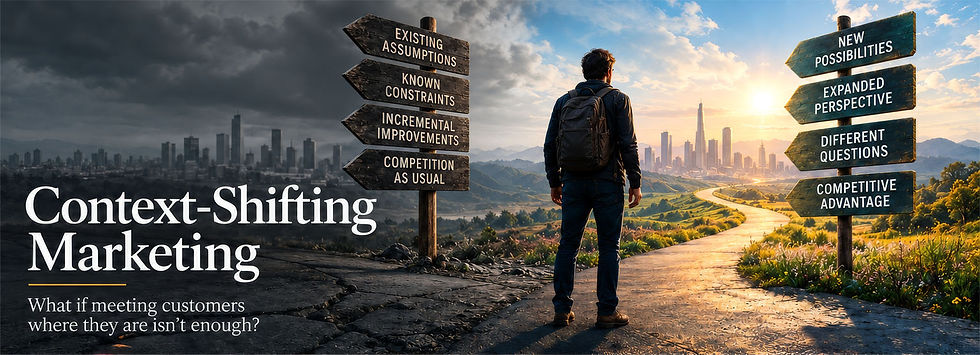
Marketers spend enormous amounts of time trying to understand customers. What do they need? What problems are they trying to solve? What do they think about our products? What messages resonate? What prevents them from buying? These are important questions, but they share an assumption that I've been thinking about, in one form or another, for roughly twenty years: we usually accept the customer's current context as a given.
We learn what customers believe and then try to position our products effectively within that existing set of beliefs. But what if the context itself is part of the problem? What if, instead of always meeting customers where they are, marketing could sometimes help them see what's possible from somewhere else?
I call this Context-Shifting Marketing.
Context Shapes What Seems Possible
For purposes of this discussion, I'll define context simply as the collection of opinions, attitudes, beliefs, assumptions and experiences that influence behavior. Most of us don't consciously inventory these things before making a decision. They're simply part of the mental framework (filter) through which we interpret the world.
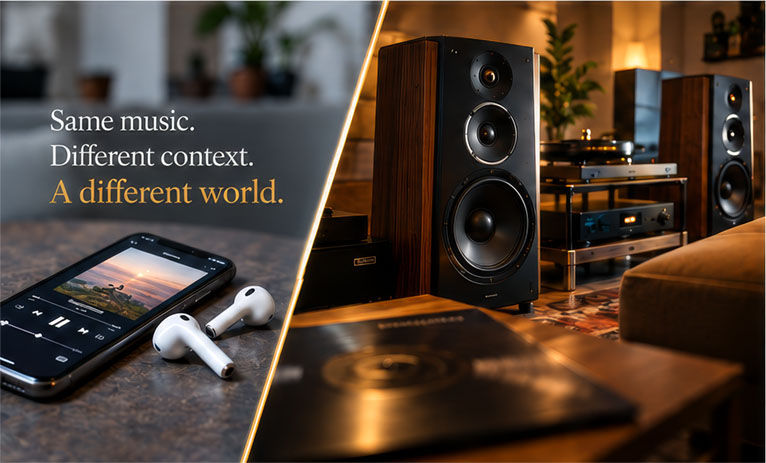
Consider music. Someone can genuinely love music and have experienced most of it through smartphones, streaming services and wireless earbuds. And let's acknowledge how extraordinary those miniature technologies are. Virtually every recording imaginable can now travel with us almost anywhere. Within that context, the problem of music reproduction may seem largely solved.
But suppose that person has never sat in front of an exceptional high-fidelity audio system. Put on a recording they know intimately and suddenly they may encounter spatial depth, instrumental timbre, dynamics, ambience and physical presence they simply didn't know reproduced music could provide. You could have spent months advertising better DACs, amplifiers and loudspeakers to this person. Twenty minutes listening might accomplish something much more important.
It changes what's possible in their mind.
Notice that we haven't convinced them to throw away their earbuds. Convenience hasn't suddenly become unimportant. We've expanded their context - and that creates new possibilities for them.
Sometimes the Technology Does the Work for Us
I saw a much more dramatic version of this during my years in biotechnology. I worked for Applied Biosystems during a period when its four-dye, one-lane DNA sequencing technology was transforming the field. Four DNA bases could be differentiated in a single electrophoretic lane, and fluorescent detection enabled automated analysis.

This wasn't a modest improvement to the existing sequencing workflow. It changed what researchers could do. The resulting context shift happened remarkably quickly. Researchers didn't need years of carefully constructed marketing messages to understand the implications of dramatically improved sequencing efficiency and automation. The technology itself was changing their context.
And then something even more powerful happened. As laboratories adopted the technology, the question shifted from “Would this technology improve my research?” to something closer to “Can my research remain competitive without it?” The innovation changed expectations. Changed expectations influenced behavior. And that behavior created additional pressure for the rest of the market to change. And that all vastly contributed to ABI's bottom line.
This is where Context-Shifting can become a formidable source of competitive advantage:
Establish a new context, and competitors may be forced to compete inside a frame that you helped create.
Every technology marketer would love to have a value proposition powerful enough to accomplish that almost by itself. Most of us aren't so lucky.
What If Marketing Has to Do the Work?
Suppose your product is meaningfully better, but it isn't revolutionary. Or suppose existing attitudes actually work against you. Then context becomes something marketers may need to understand as deliberately as we understand segments, personas, competitors and customer needs.
We can begin asking different questions. What does this market currently believe? Where did those beliefs come from? Which are strongly held beliefs and which are simply unexamined assumptions? Which influence behavior? Which help us? Which work against us? And perhaps most importantly: What evidence or experience would cause someone to reconsider them?
That last question matters because Context-Shifting isn't necessarily a messaging exercise. The mechanism might be education, demonstration, customer evidence, comparative data, thought leadership, social proof, a product trial or competitive pressure. Or, as with high-fidelity audio, a simple experience.
The objective isn't to manipulate customers into believing something convenient for us. If their existing context accurately reflects their reality, we need to honor that. The opportunity exists when their context is incomplete, outdated or missing possibilities that customers haven't yet experienced.
This Idea Has Some Academic Relatives
I wanted to know whether twenty years of keeping this idea largely inside my own head had caused me to reinvent something marketing academics settled long ago. The answer is reassuringly complicated.
In 2000, Bernard Jaworski, Ajay Kohli and Arvind Sahay distinguished between companies that are market-driven - understanding and responding to preferences and behaviors within an existing market - and companies that drive markets by attempting to influence market structure or the behavior of market participants. Importantly for this discussion, their framework includes indirectly changing behavior by changing people's mindsets.
A broader body of research has subsequently developed around market shaping. A 2021
meta-analysis examined 79 qualitative market-shaping studies and identified recurring activities organized into three phases: introducing change, forming the changed market and retaining it. Another fascinating branch approaches market shaping through sensemaking, sensegiving and sensebreaking - examining how people construct meaning and how market participants can influence that process. Research into proactive market orientation also distinguishes responding to customers' expressed needs from uncovering latent opportunities for customer value that customers themselves may not yet recognize.
So I'm certainly not claiming that marketers haven't thought about changing markets or customer mindsets before. What I find useful about Context-Shifting Marketing is its practical focus on one particular part of that much larger problem:
Understand the context that makes current customer behavior rational. Identify whatin that context limits different behavior. Then determine whether better information, evidence or experience can legitimately expand or change it.
That gives us something we can potentially put on the marketer's tool belt. A preliminary framework might look like this:
Current Context → Contextual Barrier → Desired Context → Shift Mechanism → Evidence or Experience → Context Shift → Behavioral Change
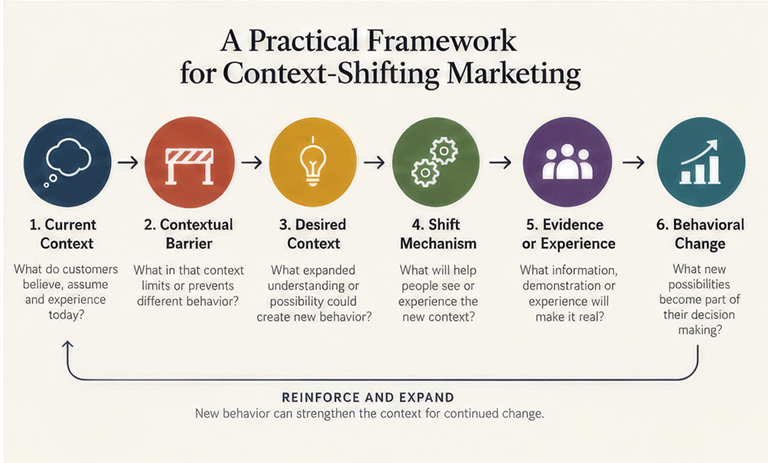
It's deliberately simple, because the hard part isn't drawing the diagram. The hard part is understanding the context.
Which Brings Me to AI
Artificial intelligence may be one of the largest context shifts of our lifetimes. But listen to how much of the current conversation is framed: AI is complicated. AI may be dangerous. What jobs will AI eliminate? What happens to my organization if AI performs work currently performed by people? AI experts understand the technology, but do they understand my customers, my business or marketing?
Some of these are legitimate concerns. AI presents real questions involving reliability, governance, security, employment and responsible use. Ignoring those issues would be foolish. But notice the context underlying many of the questions: we're trying to understand what AI will do to the world we already have.
That's perfectly natural. It may also be limiting our ability to understand AI.
From Substitution to Possibility
The question that increasingly interests me isn't What will AI replace? It's What will AI make possible?
That sounds like a subtle change. I don't think it is. The first question begins with today's organization, today's workflows, today's knowledge, today's constraints and today's ambitions. Then it asks where AI fits. The second allows us to imagine different workflows, new capabilities, greater ambitions - and things that previously weren't practical at all.
A marketer might suddenly have access to analytical capabilities that previously required a specialized team. A small company might contemplate a sophisticated integrated campaign that previously exceeded its resources. A person can investigate an unfamiliar subject at extraordinary speed, moving interactively from elementary concepts into increasingly sophisticated ones. Someone with an idea can test assumptions, encounter opposing arguments, explore related scholarship and discover connections that might otherwise have taken weeks - or never happened.
That last one matters enormously to me. AI can accelerate learning. And accelerated learning isn't merely doing the same learning faster. Sometimes it changes what we're willing to learn in the first place.
The cost - in time, effort and access to expertise - of following an intellectual rabbit hole has collapsed. Questions that once weren't worth pursuing because of the work required to answer them can now lead immediately to another question, another connection and another field of knowledge.
That expands possibility too.
The Mistake May Be the Question We're Asking
I don't think we should stop worrying about AI's consequences. I don't think every AI application is beneficial. And I certainly don't think organizations should adopt technology simply because everyone else is talking about it. But I do think there's a contextual trap here.
The mistake isn't worrying about the consequences of AI. The mistake is evaluating AI exclusively through the assumptions and constraints of the world before AI.
DNA sequencing provides an interesting historical analogy. When a fundamentally different sequencing technology arrived, the most important question eventually wasn't how to squeeze it into the old workflow. The technology changed what the workflow could be.
AI may require us to exercise that same intellectual muscle. Instead of asking only How will AI affect what we currently do?, we should also be asking How might we operate differently because AI exists? And: What can we now attempt that wasn't practical before?
There's One More Thing You Should Know About This Article
I've been thinking about Context-Shifting Marketing, in one form or another, for roughly twenty years. Mostly, the idea stayed in my head. I didn't have the right people around me with whom to really explore it, so occasionally I'd think about it, turn it over mentally, and put it back on the shelf.
Today I started talking about it with AI. I explained the idea, and AI pushed on it. I supplied examples, and we pulled them apart. One idea led to another. We explored the academic literature and discovered where my thinking intersected with established marketing theory - and where my particular formulation might still be useful.
I clarified what I meant. The AI occasionally misunderstood me, and I corrected it. It made connections I hadn't made. I made connections it hadn't made. And in roughly an hour, something I'd carried around largely by myself for twenty years had become a concept structured well enough that I could communicate it to you.
The conventional interpretation of that story might be: AI helped me write this article faster.
It did. But that may be the least interesting thing that happened.
No colleague was displaced. No task I'd previously assigned to someone was automated away.
Something that hadn't happened for twenty years happened. I learned. I developed an idea. And now I can share it with countless other people who can challenge it, improve it, reject it or take it somewhere I haven't imagined.
That's accelerated learning. That's expanded capability. And, at least for me, that's the context shift.
So perhaps the question to leave with isn't What will AI do to what I do today?
It's something much more interesting.
What becomes possible?
Is your market trapped in an outdated context?
At BB Marketer, I help complex B2B technology companies reframe buyer expectations and establish new market standards.
Research & Further Reading
Jaworski, B., Kohli, A. K., & Sahay, A. (2000). Market-Driven Versus Driving Markets. Journal of the Academy of Marketing Science, 28(1), 45–54. Sage JournalsView publication
Narver, J. C., Slater, S. F., & MacLachlan, D. L. (2004). Responsive and Proactive Market Orientation and New-Product Success. Journal of Product Innovation Management, 21(5), 334–347. DOIView publication
Flaig, A., Kindström, D., & Ottosson, M. (2021). Market-shaping phases—a qualitative meta-analysis and conceptual framework. AMS Review, 11, 354–374. Springer LinkOpen-access article
Kleinaltenkamp, M., Karpen, I. O., & Kleinaltenkamp, M. J. (2022). A sense-based perspective on market shaping: Theorizing strategies for the origination and propagation of new resource linkages. Industrial Marketing Management, 100, 145–156. ScienceDirectView publication