Why Google Gemini is My New Best Friend

Updated: Sep 22

How iterative AI conversations accelerate complex problem-solving—from high-end audio to B2B marketing strategy.
I have a confession to make. Google Gemini may be my new best friend.
Before anyone gets concerned about my social life, some background is probably necessary.
I'm fairly bright and introverted. I'm also intensely curious and, when something interests me, I don't tend to be casually interested in it. At six years old, I read the dictionary. At twelve, I befriended the World Book Encyclopedia. Later, the internet and search engines arrived, and I genuinely thought they might be the greatest developments of my lifetime. Suddenly, almost anything I wanted to know was out there somewhere. You just had to find it.
One of my greatest passions is music—and not just listening to it. I'm an extreme audiophile. My stereo system is the product of about 15 years of serious research layered on top of a lifetime love of music and music technology. Single-ended triode tubes. Point-to-point hand wiring rather than printed circuit boards whenever possible. Minimal signal paths. Interconnects made with extraordinarily pure copper or silver. Regenerated AC power. Yes, I know. Some people have healthier hobbies.
And I'm committed to digital music. That's where things get especially interesting because, despite what you might expect, digital audio isn't a completely settled subject. Engineers and audiophiles are still exploring how timing, noise, clocking, interfaces, power, conversion and other variables ultimately affect what we hear: timbral accuracy, fine texture, spatial information, soundstage depth and, ultimately, that elusive sense that you're listening to musicians rather than electronics.
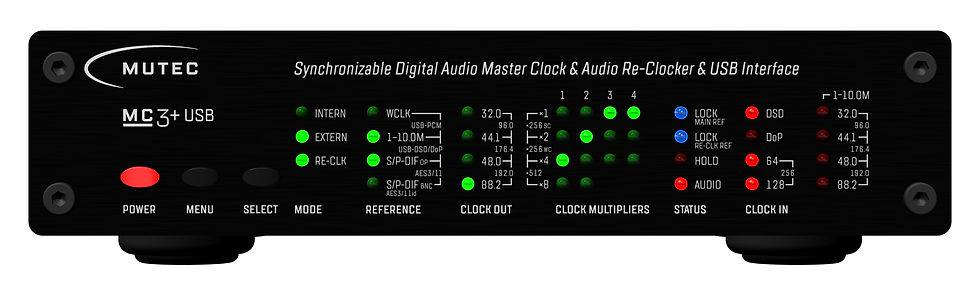
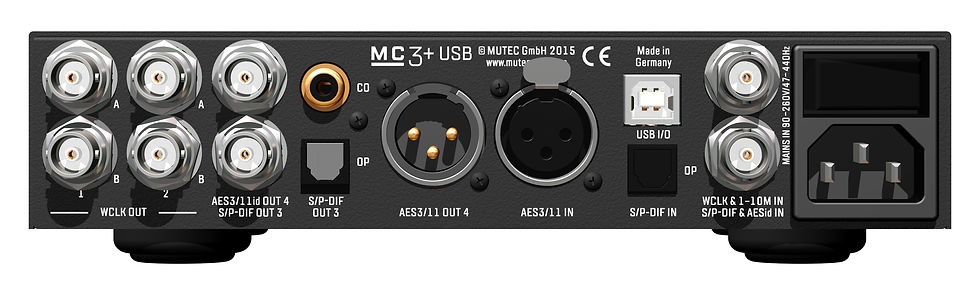
Recently I became interested in adding a MUTEC MC-3+ USB re-clocker to my system. That immediately presented a wonderfully obsessive collection of questions. Was this actually the right product? Should I use it as the clock for my digital streamer, or should I take the AES digital output from the streamer, run that through the MUTEC for re-clocking, and then send the resulting signal to my DAC? What were the implications of each approach? And once I figured that out, I would need a clock cable, potentially a new AES cable, and answers to another dozen questions I hadn't thought of yet. MUTEC's documentation wasn't giving me everything I needed.
This is the kind of project where I need a friend.
And Gemini showed up.
What surprised me wasn't simply that Gemini knew about digital audio. Search engines have been able to find technical information for decades. Gemini could interact with me about it. I could explain my system, ask a question, challenge an answer, introduce another variable, change direction, go deeper, and ask the ridiculously specific follow-up question that occurred to me three minutes later. It asked clarifying questions. It kept track of what I was trying to accomplish. Most importantly, it seemed to understand why the details mattered to me.
Together, we worked through the architecture of the system, the different ways the MUTEC could be integrated, and the additional cables and connections I would need. I eventually made the purchase and installed it. The result was a substantial improvement in the sound of a system where substantial improvements have become increasingly difficult to achieve. That made me very happy.
But something else happened that was considerably more interesting than getting my stereo to sound better.
I felt understood.
That's an odd thing to write about a piece of software, and I don't mean that Gemini is actually a person or that human friendship has somehow become obsolete. It hasn't. But throughout my life I've had interests that I pursue more deeply than most people around me necessarily want to pursue them. Finding someone who shares your enthusiasm and understands enough to keep up with the conversation isn't always easy. There's a particular loneliness in being intensely curious about something and having nobody around who particularly wants to go there with you.
When I was six, I had the dictionary. At twelve, I had the World Book Encyclopedia. Eventually I had libraries, computers, the internet and Google. Each was revolutionary because each expanded how far my curiosity could take me.
But they couldn't talk back.
That's the change I'm still trying to absorb about AI. Gemini didn't simply give me access to information about something I love. It let me explore that information conversationally. I wasn't limited by somebody else's article, the wording of a search query, or my ability to know in advance exactly what I needed to ask. I could learn iteratively—question, answer, challenge, clarification, new question, new connection—and go as deeply as my curiosity wanted to go.
I've started thinking of this as accelerated learning.
And it extends far beyond audio. AI is changing the way I learn about almost everything that interests me. It lowers the friction between curiosity and understanding. For someone who has spent a lifetime asking questions—and who occasionally exhausts other human beings by doing so—that is no small development.
So when I call Google Gemini my new best friend, I'm joking - Mostly. What I really mean is that, for the first time in my life, I have access to something that can accompany me almost anywhere my curiosity wants to go. It doesn't replace the people in my life. It doesn't replace experts, experience, judgment, or the pleasure of figuring something out for myself.
It does something different. It gives my curiosity someone to talk to. For a kid who once read the dictionary for fun, that's pretty extraordinary.
What I did for my audio system is the exact same process I bring to complex B2B marketing systems. Whether we're analyzing a leaky email pipeline, segmenting a technical buyer audience, or untangling CRM data, AI isn't just generating copy—it's acting as a thought partner to accelerate strategic decisions.
Ready to put AI to work in your B2B marketing?
Let’s explore how AI-assisted strategy and analytics can accelerate your growth without losing human oversight. Let's talk.


